
CSIR NET June 2015 Q87: Seismology (Core Phases)
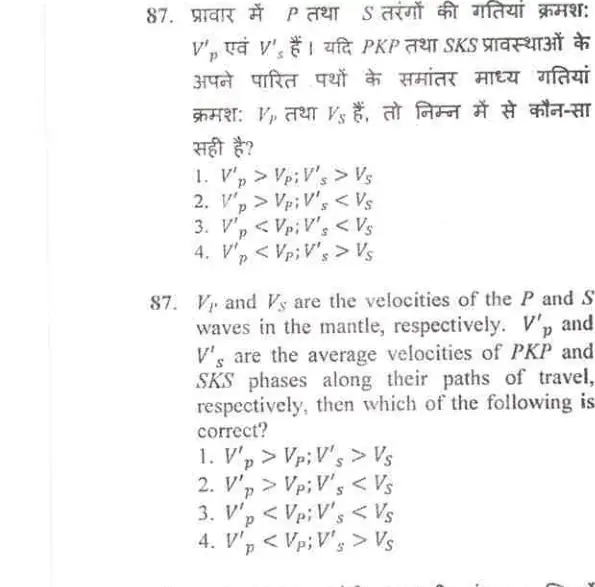
Comparing whole-path average velocities of PKP and SKS core phases to mantle-only P and S velocities, based on the seismic properties of the liquid outer core.
PKP travels as a P-wave through the mantle, then through the liquid outer core (where P-wave velocity is markedly lower than in the lowermost mantle, since P-velocity drops sharply across the core-mantle boundary), then back through the mantle. This slower core segment pulls the path-averaged velocity V'_p below the pure mantle P-velocity Vp, so V'_p < Vp. SKS travels as an S-wave in the mantle, but since S-waves cannot propagate through the liquid outer core, it converts to a P-wave while crossing the core (where P-velocity, ~8-10 km/s, is actually higher than typical mantle S-wave velocity Vs, ~7 km/s) before converting back to S in the mantle. This faster core-crossing P-wave segment raises the path-averaged velocity V'_s above the pure mantle S-velocity Vs, so V'_s > Vs.
Option 4 (V'_p < Vp; V'_s > Vs) correctly captures both effects: the core's low P-velocity lowers the PKP average, while the core-crossing P-to-S conversion in SKS raises its average above pure mantle S-velocity. The other options get the sign of one or both inequalities wrong.