
CSIR NET Dec 2015 Q105: Meteorology
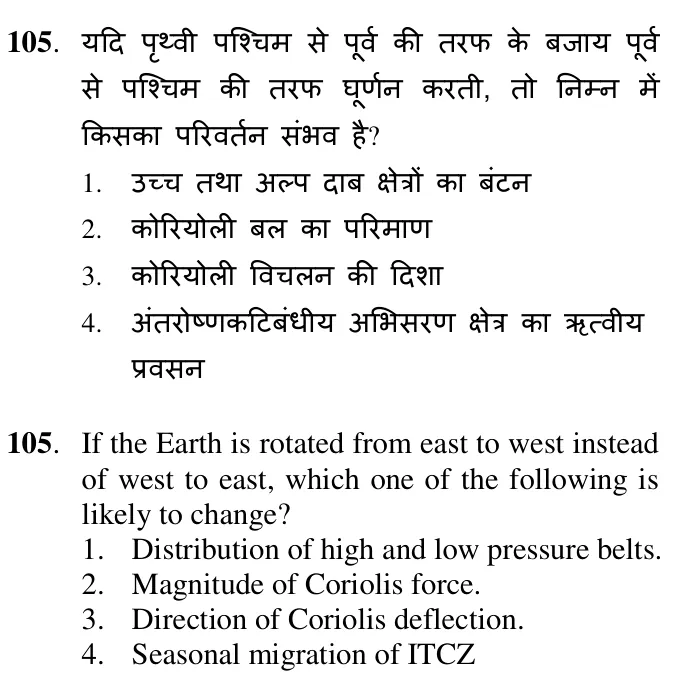
Effect of reversed Earth rotation direction on atmospheric circulation and the Coriolis force
If Earth's rotation direction were reversed (east-to-west instead of west-to-east), the fundamental physics generating the Coriolis effect would still operate (Earth would still be rotating, just in the opposite sense), so the magnitude of the Coriolis force (which depends on rotation rate, latitude, and wind speed, not on rotation direction) would be unchanged. Global pressure belt distribution (driven by differential solar heating and the resulting Hadley/Ferrel/Polar cell structure by latitude) and the seasonal migration of the Inter-Tropical Convergence Zone (driven by the sun's apparent north-south seasonal movement, independent of rotation direction) would also remain unchanged. However, the Coriolis force's deflection direction (currently causing rightward deflection in the Northern Hemisphere and leftward in the Southern Hemisphere) is tied directly to the sense of Earth's rotation; reversing rotation direction would reverse the sign of the Coriolis parameter, flipping the deflection to leftward in the Northern Hemisphere and rightward in the Southern Hemisphere. This matches option 3.
Option 1 (distribution of high and low pressure belts) would not change, since pressure belt distribution is governed by latitudinal solar heating patterns, not by the sense of Earth's rotation. Option 2 (magnitude of Coriolis force) would also remain the same, since the Coriolis force's magnitude depends on rotation rate and latitude, not on rotational sense. Option 3 is correct: reversing the rotation direction reverses the sign of the Coriolis parameter, flipping the direction (not magnitude) of Coriolis deflection in both hemispheres. Option 4 (seasonal migration of ITCZ) would remain unaffected, as ITCZ migration follows the sun's seasonal declination changes, which are unrelated to Earth's spin direction.