
CSIR NET Dec 2015 Q95: Geophysics
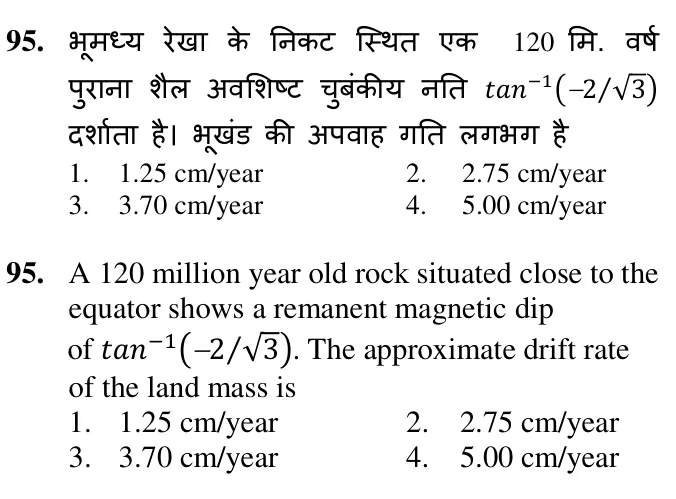
Paleomagnetic inclination, paleolatitude, and continental drift rate calculation
The magnetic dipole inclination-latitude relation is tan(I) = 2 tan(lambda), where I is inclination and lambda is (paleo)latitude. Given I = tan^-1(-2/sqrt3), we have tan(I) = -2/sqrt3. Setting 2 tan(lambda) = -2/sqrt3 gives tan(lambda) = -1/sqrt3, so lambda = -30 degrees (i.e., 30 degrees S paleolatitude, negative inclination indicating southern hemisphere at time of magnetization). Since the rock is presently situated close to the equator (paleolatitude ~0 degrees) but recorded a magnetization corresponding to 30 degrees S, the landmass has drifted through a north-south angular distance of 30 degrees over 120 million years. Converting: 30 degrees x ~111 km/degree = 3330 km = 3.33x10^8 cm. Drift rate = 3.33x10^8 cm / 120x10^6 years ≈ 2.775 cm/year, closest to option 2 (2.75 cm/year).
Option 1 (1.25 cm/year) underestimates the drift distance, corresponding to roughly half the correct angular displacement. Option 2 is correct: dividing the 30-degree (~3330 km) angular displacement by 120 million years yields approximately 2.75 cm/year, matching the standard paleomagnetic pole-wander calculation. Option 3 (3.70 cm/year) overestimates the rate, as if using a larger paleolatitude or shorter time span than given. Option 4 (5.00 cm/year) substantially overestimates the drift rate and does not correspond to the 30-degree paleolatitude displacement implied by the given inclination.