
CSIR NET Dec 2015 Q54: Geophysics
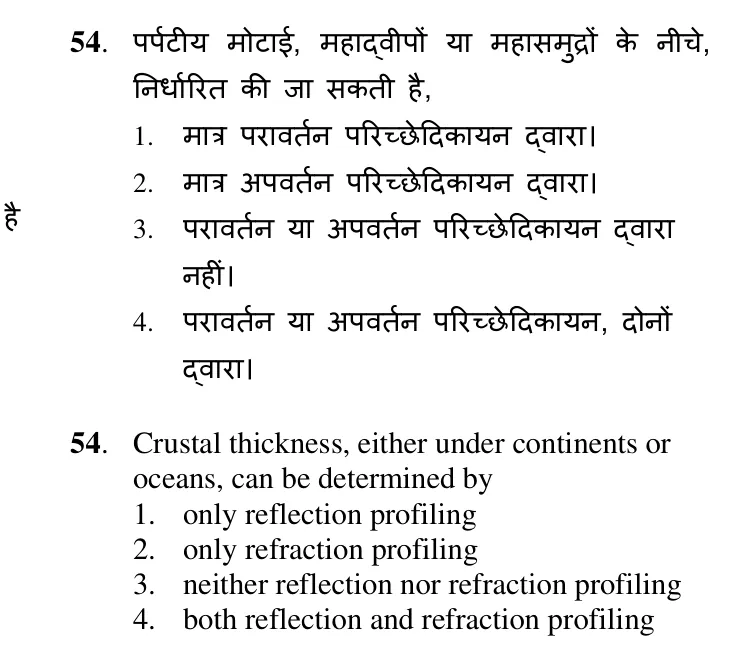
Seismic refraction profiling, which analyzes the travel times of head waves critically refracted along velocity discontinuities like the Mohorovicic discontinuity (Moho), is the classic method for determining crustal thickness beneath both continents and oceans.
Crustal thickness is classically determined using seismic refraction profiling, which measures the travel times of seismic waves critically refracted along the Moho (the crust-mantle velocity boundary) to calculate the depth to this discontinuity beneath both continental and oceanic crust. Option 2 is correct.
1) Incorrect -- reflection profiling alone is primarily used for imaging shallower stratigraphic/structural layering rather than determining the crust-mantle boundary depth via travel-time analysis in the classic sense. 2) Correct -- refraction profiling using critically refracted head waves along the Moho is the standard classic method for crustal thickness determination. 3) Incorrect -- crustal thickness determination is indeed possible and has long been achieved using refraction seismology. 4) Incorrect -- while reflection profiling can supplement modern crustal studies, the fundamental classic method used to establish crustal thickness relies on refraction profiling, not a strict combination requirement.