
CSIR NET Dec 2015 Q48: Geophysics
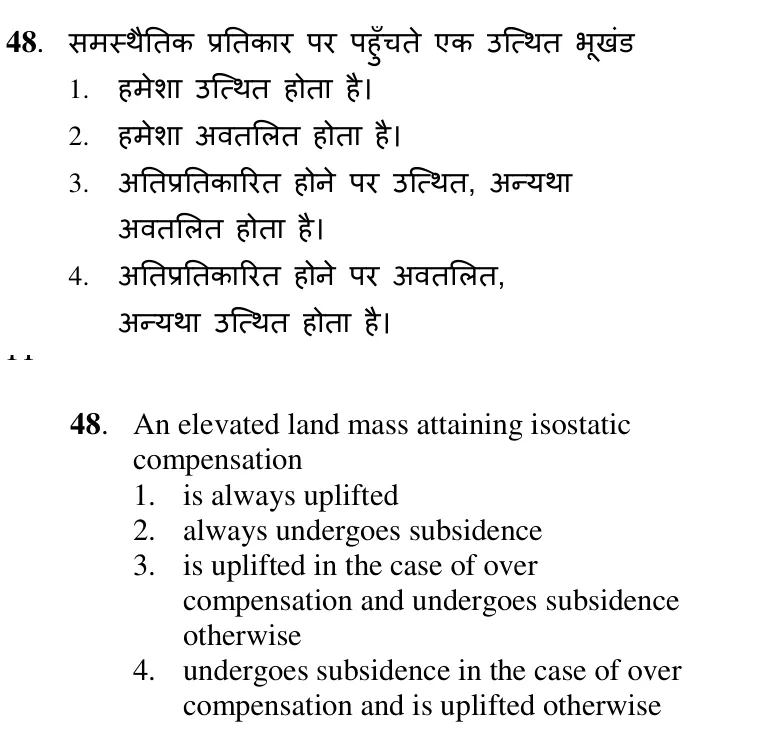
Isostatic compensation describes the equilibrium balance between crustal buoyancy (root) and topographic load; a landmass that is 'overcompensated' has more buoyant support (root) than needed for its current elevation and will be uplifted (isostatic rebound), while an 'undercompensated' landmass has insufficient buoyant support and will subside.
An elevated landmass approaching isostatic equilibrium behaves according to its compensation state: if it is overcompensated (has more buoyant crustal root than needed to support its current topography, e.g., after erosion has removed surface load faster than the root can adjust), it will be uplifted to restore equilibrium; if it is undercompensated (insufficient root/buoyancy for its elevation), it will undergo subsidence to move toward equilibrium. Option 3 is correct.
1) and 2) Incorrect -- these describe only a single unconditional behavior (always uplifted, or always subsiding), ignoring the fact that the direction of isostatic adjustment depends on whether the landmass is over- or under-compensated. 3) Correct -- captures the correct conditional relationship: overcompensation drives uplift, undercompensation drives subsidence, as the landmass moves toward isostatic equilibrium. 4) Incorrect -- reverses the correct relationship between over/under-compensation and the resulting vertical motion.